Memory is a poor baseline
Most bird owners can describe a dramatic change. The harder question is whether breakfast took five minutes longer, the usual morning call shortened gradually, or the bird has chosen the lower perch a little more often this week. Memory is good at stories and poor at quiet trends.
That limitation matters because birds may conceal illness and early changes can be subtle. The solution is not constant surveillance or a home diagnostic system. It is a small, sustainable record of what this individual normally does while well. A baseline makes “different” more concrete and gives an avian veterinary team better history when something changes.
Useful data do not have to look clinical. A weight recorded under repeatable conditions, a brief note about actual intake and ordinary activity, or a short video of a normal vocal routine can preserve information memory would smooth away. The goal is not to interpret every variation. It is to notice patterns without pretending that observation can name their cause.
Recording normal days also prevents the log from becoming a collection of worries. It shows the range of ordinary variation against which a later change can be described.
Observation is part of the relationship
A baseline begins with attention already present in good care. What food is actually consumed rather than merely offered? When is the bird usually active or quiet? Which calls, postures, resting places, droppings, and social responses are ordinary for this individual, diet, and routine?
Those observations are relational because their meaning comes from familiarity. A vocal species profile cannot tell you whether this bird's morning is unusually quiet. A generic dropping photograph cannot account for what this bird recently ate. A one-time weight at home has limited context until it is compared with measurements made consistently and with veterinary records.
Keep description separate from interpretation. Write “left most of breakfast; ate the evening portion” rather than “lost appetite because stressed.” Record “rested on the lower perch twice after lunch” rather than “weak.” A veterinarian may ask questions that reveal an ordinary explanation or recommend examination. The record's job is to preserve what happened, not decide which explanation wins.
Context belongs beside the observation. Note a new food, altered light schedule, travel, a noisy repair, medication directed by a veterinarian, or a changed cage arrangement. Context can prevent false certainty, but it should not be used to dismiss a change automatically. “There was construction today” and “the bird was quieter” are two facts; the first does not prove the cause of the second.
This practice should feel like knowing the bird, not policing it. Thirty attentive seconds at a predictable point in the day can be more reliable than a long retrospective note written only when worry begins.
Make weighing repeatable, not dramatic

The Association of Avian Veterinarians recommends that owners have an electronic gram scale and weigh companion birds weekly. Your avian veterinarian may recommend a different schedule for a young, ill, recovering, changing-diet, or otherwise monitored bird. Follow that individual plan rather than turning a general cadence into a rule.
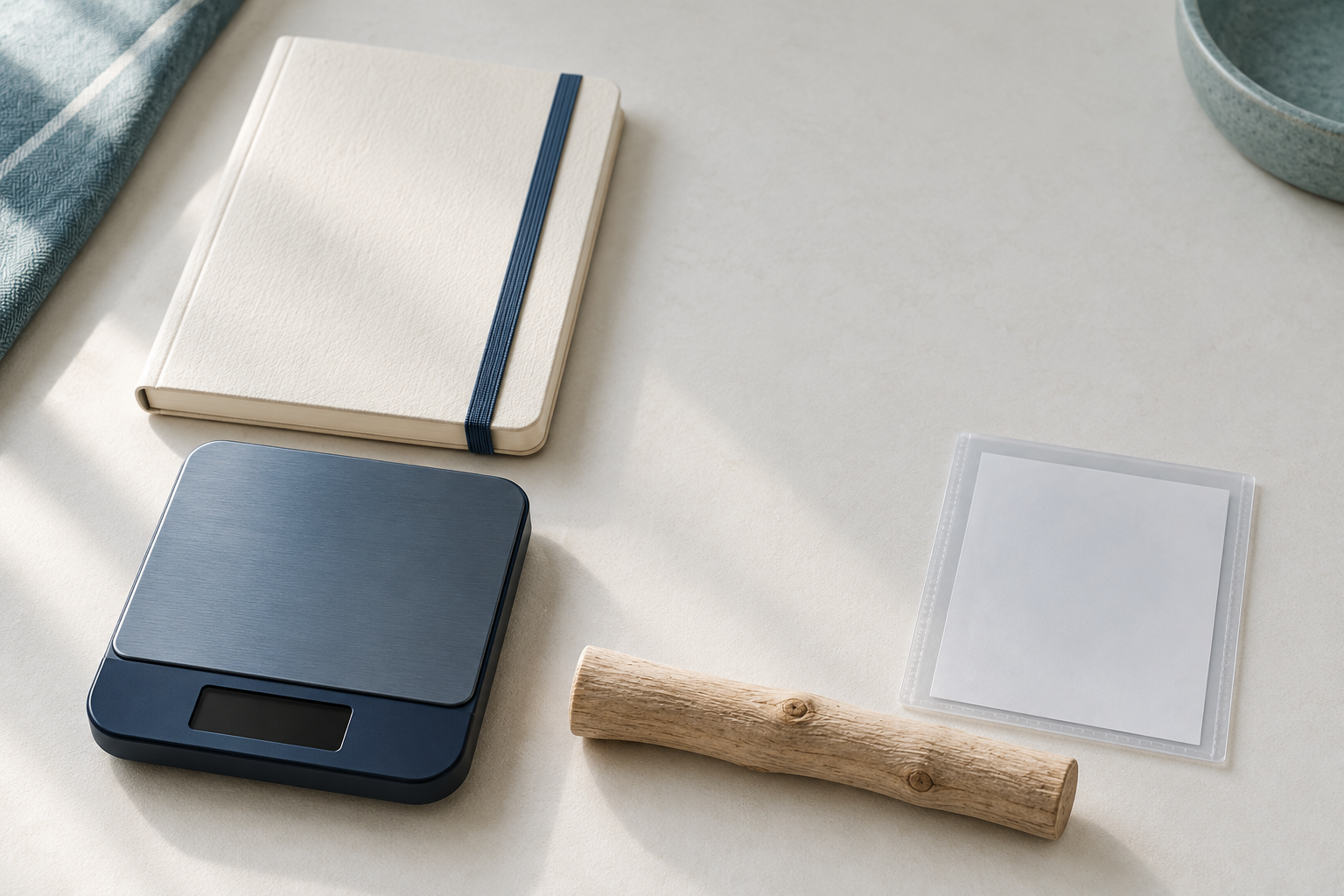
Choose a scale that reads in grams and is appropriate for the bird's size. Place it on a firm, level surface. A stable platform or perch can help, but it must not tip, slide, or force an uncomfortable stance. If a removable perch is used, tare the scale with the empty perch in place so the display excludes its weight.
Make the conditions as consistent as practical: similar time of day, the same scale and perch, and the same relationship to meals. Record the displayed value immediately rather than rounding from memory. Do not compare a morning pre-meal measurement with an evening post-meal measurement as though the conditions were identical.
Teach weighing through voluntary, rewarded steps. Reinforce looking at or approaching the scale, then touching it, stepping onto the platform, and remaining long enough for a stable reading. Never chase, grab, or frighten a healthy bird for a routine measurement. If weighing is difficult, ask an avian veterinary team or qualified positive-reinforcement trainer to help design a low-stress method.
The graph is a communication aid, not a diagnosis. Species averages cannot replace an individual's body condition, history, and veterinary assessment. Do not invent a universal alarm line or change food in response to a number without professional guidance. If a reading looks surprising, check the equipment and conditions once; if the change is sudden, meaningful, repeated, or accompanied by any other concern, contact the veterinarian rather than waiting for a prettier trend.
Build the smallest useful record—and know what to share

A sustainable record can fit on one line per day:
Date | food actually eaten | ordinary activity/voice | droppings/routine | context | weight, if scheduled
Use a check mark for “within this bird's usual range” and a few words only when something differs. Review the notes once a week. The review asks whether a change repeated, widened, or returned to baseline; it does not assign a disease. Optional photos or short videos can capture normal movement, breathing at rest, vocalization, or an unusual event, provided recording does not delay care or stress the bird.
Here is a fictional seven-day example that deliberately avoids diagnosis:
- Monday: normal breakfast and activity; routine droppings; 86 g under usual morning conditions.
- Tuesday: normal; visitor in the afternoon.
- Wednesday: ate breakfast later; otherwise within usual range.
- Thursday: normal intake; quieter during morning construction noise.
- Friday: normal voice and activity; produce changed from carrot to leafy greens.
- Saturday: normal; no scheduled weight.
- Sunday: breakfast again later than usual; note retained for weekly review.
This record does not prove why Wednesday or Sunday differed. Its value is that timing, context, and the bird's return—or failure to return—to ordinary patterns are no longer dependent on recall.
When contacting a clinic, compress the record into a factual summary: “Over seven days, breakfast intake was lower on Wednesday and Sunday; activity and voice remained within the usual range; the last consistently measured weight was 86 g on Monday; there was construction Thursday; no diet change except the listed produce.” Include species, age if known, current diet, medication, relevant history, and when the change began. Offer the full log, photos, or videos if the team wants them.
Do not wait to complete a week when a change is sudden, meaningful, worsening, or accompanied by a concern. Use Is My Bird Sick? for the site's safety-first contact guidance and call an avian veterinarian. The baseline is meant to shorten uncertainty and improve communication, never to create a home-observation delay.
The best record is not the most detailed one. It is the one the household can keep while the bird is well, understand without guesswork, and share when professional judgment is needed. “Normal” becomes health data when it is lightly, consistently observed—and when its interpretation stays in the right hands.