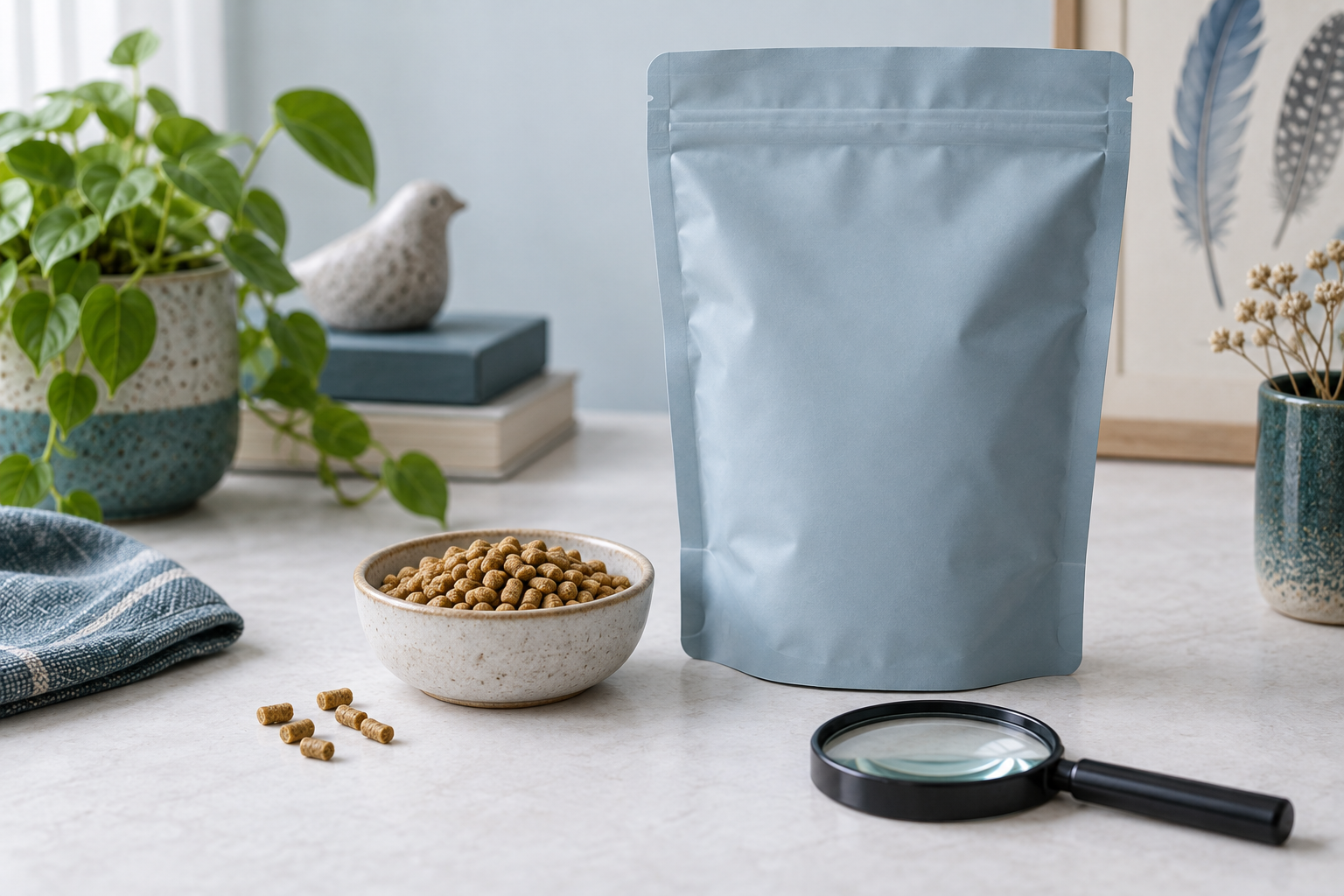
Turn the bag around
The front of a bird-food bag is a sales surface. The useful reading begins when you turn it around. A label can identify the product, show which ingredients are listed, provide a limited nutrient analysis, state feeding and storage directions, and preserve traceability. It cannot prove that the food is ideal for your bird, that every marketing claim is meaningful, or that the manufacturer has answered every quality question.
This research-based review walks through an anonymized current label for a small-bird maintenance pellet checked on October 13, 2026. It is not a brand ranking or a feeding recommendation. The example is real so the method has friction; the brand is withheld in the discussion so attractive packaging cannot become the verdict.
First pass: identity, intended bird, and directions
Start with the product's statement of identity. Is it described as food, a maintenance formula, a treat, a supplement, or something else? The example calls itself a maintenance formula for named small birds and limits that description to healthy, non-breeding, non-molting birds. Those qualifiers are more informative than a broad phrase such as “for parrots.”
Next find the species and life-stage language. A pellet size that physically fits a budgie does not establish that the formula suits the bird's life stage or medical situation. Breeding, growth, recovery, chronic disease, and species with specialized diets can change the question. Put any mismatch on a veterinarian list rather than solving it from the package.
Then read every feeding direction, including transition notes and directions for other foods. The example tells users to offer fresh food daily, describes meal-based use, gives a table as a guideline, and publishes a percentage claim for the broader diet. A direction is evidence of what the manufacturer intends; it is not independent proof that the direction is right for every bird.
Look for operational details too: how quickly opened food should be used, whether it should remain in the original bag, and how the package should be closed or stored. A sophisticated nutrient panel cannot rescue food stored against the manufacturer's instructions.
Ingredients and guaranteed analysis: useful, but narrower than they look

In the United States, FDA labeling rules require animal-food ingredients to be listed from most to least by weight. The example begins with several whole grains and legumes, followed by seeds, plant ingredients, mineral sources, and a vitamin/mineral supplement. That sequence tells you order by formulation weight before processing. It does not reveal the exact percentage of each ingredient, the finished food's digestibility, batch consistency, contaminant testing, or how nutrients are available to a particular bird.
Ingredient order can also be misread as a moral ranking. A familiar whole food near the top may feel reassuring, while a technical nutrient name may look suspicious. Neither reaction measures whether the complete formula meets the intended bird's needs. Conversely, a long vitamin list does not prove adequacy. Use the list to identify declared ingredients, potential questions, and changes between packages—not to award a quality score from vocabulary.
The example's guaranteed analysis states minimum crude protein and crude fat, maximum crude fiber and moisture, plus minimum omega-6 and omega-3 fatty acids. “Minimum” does not mean the bag contains exactly that number; “maximum” does not mean it always reaches the limit. These are boundaries for the listed measures.
AAFCO's consumer guidance explains the common dog- and cat-food guarantees and notes that “crude” refers to analytical methods. That page is useful for understanding ingredient order and the form of guarantees, but its dog and cat nutrient profiles are not a bird adequacy standard. Do not search a bird pellet for a dog- or cat-style nutritional-adequacy statement and then assume its presence or absence settles the avian question.
Guaranteed analysis also cannot be compared casually across foods with different moisture. Nor does crude protein tell you the amino-acid pattern, or crude fat the complete fatty-acid profile. Some manufacturers publish expanded technical data, but extra numbers still need context: method, units, as-fed versus dry-matter basis, normal variation, and relevance to the species.
Claims, color, and the confidence they do not earn
Sort claims into three buckets.
Verifiable label facts include the named species group, net weight, ingredient list, guaranteed values, directions, company identity, and lot code. These may still change, so check the package in hand.
Defined or externally checkable claims may include a certification with a named certifier or a regulatory term with published criteria. Verify the certifier and scope. A certification about agricultural production does not automatically prove nutritional suitability, palatability, or medical benefit.
Promotional claims include words such as premium, natural, wholesome, balanced, superior, or longevity-supporting. Some may reflect a defensible company position, but the word alone does not disclose the evidence. FDA requires animal foods to be truthfully labeled and reviews certain health-related pet-food claims, yet a compliant label is not a personalized feeding plan.
Color deserves similar restraint. A uniformly colored pellet is not automatically inferior, and a naturally variable pellet is not automatically better. Check the ingredient statement for declared color additives and ask why color matters to the product. Appearance cannot tell you how the food was tested or whether your bird will consume enough of it.
When a package makes a strong health claim, look for a specific explanation and evidence you can evaluate. If the support is only another marketing sentence, confidence should remain limited. Do not turn “veterinarian recommended” into a trial result unless the company states who recommended it, how that group was selected, and what exactly was evaluated.
Traceability and the questions the bag leaves open

Find the manufacturer or distributor contact, lot number, and best-by or use-by date before discarding the package. FDA explains that a lot code identifies a specific batch and helps companies and regulators investigate complaints or recalls. It recommends keeping the original packaging or photographing the code. A barcode identifies the product, not necessarily the plant and batch.
Check the current FDA recall database by company and product, but interpret it carefully. No listed recall is not proof that a food has never had a problem or that future batches are risk-free. A past recall is not, by itself, a complete assessment of current controls. Record the date you checked and the exact product identity.
Then write the questions the label cannot answer:
Treat a refusal to answer basic product questions as information too.
- Who formulates the food, and what avian nutrition expertise is involved?
- Which species and life stages were considered, and what evidence supports the intended use?
- Are finished batches analyzed, and which values are tested rather than calculated?
- How are ingredient identity, contaminants, and manufacturing changes controlled?
- Can the company provide current technical data and explain normal batch variation?
- How should this food fit the rest of a specific bird's diet?
Send product-process questions to the manufacturer and bird-specific nutrition questions to an avian veterinarian. A company should be able to explain its own product, but it cannot examine your bird through a customer-service form.
Use a final five-part check: identity, intent, declared contents, directions, and traceability. If one is missing or vague, record the gap. If everything is present, keep the conclusion modest: the label is usable, not omniscient.
The best label reader is neither impressed by every claim nor suspicious of every unfamiliar term. They know which fields are regulated facts, which numbers have limited scope, which statements need outside verification, and which decisions require a veterinarian who knows the bird.