This is a research-based category review, not a hands-on product test or medical recommendation. Air-cleaner models, filters, and claims change, so specifications should be checked on the manufacturer's current page and in independent certification directories on the day of purchase.
What an air purifier can—and cannot—change
A well-sized mechanical air cleaner can reduce airborne particles that pass through its filter. In a bird home, those particles may include some feather dust, dried debris, and particles entering from outdoors. It cannot make a room free of dust, stop debris at the cage, remove every gas or odor, or repair poor ventilation. It also cannot diagnose, prevent, or treat illness in a bird or person.
That boundary should shape the purchase. The US Environmental Protection Agency describes filtration as a supplement to source control and ventilation, not a replacement. Large particles may settle before reaching a machine; gases require different media from particles; and a portable unit normally serves a room or defined area rather than an entire home.
Bird households still need frequent surface and floor cleaning, clean bowls and liner, safe fresh-air exchange when outdoor conditions allow, and removal of pollutant sources. The Association of Avian Veterinarians warns that smoke and strong fumes can be hazardous to birds. A filter is not permission to use scented sprays, smoke, unsafe cookware, or an ozone-producing device nearby.
The category verdict is therefore conditional: a mechanical HEPA unit can be a useful particle-control tool when it is correctly sized, quiet enough to run, affordable to maintain, and free of intentionally ozone-producing features. Marketing language alone cannot establish any of those conditions.
The scorecard: room size, CADR, filtration, noise
Begin with the room, not the brand. Measure the length and width of the connected area the unit must serve. Open plans should be treated as the whole connected volume, and unusually high ceilings require more capacity than the same floor area with a standard ceiling.
Next find a clean air delivery rate, or CADR. EPA explains that CADR represents the amount of contaminant-free air delivered, combining particle-removal efficiency with airflow. A higher number can serve a larger space or provide more cleaning at a given setting. Smoke, dust, and pollen CADRs represent different particle-size ranges; smoke CADR is the more informative published value when smaller particles are the concern. Compare values measured under the same standard rather than a brand's undefined “coverage.”
Do not confuse a HEPA label with delivery. A high-efficiency filter attached to a weak fan, restricted by a dirty prefilter, or operated only on its lowest setting may move less clean air than the shopper imagines. Conversely, a product may publish CADR without using the word HEPA. Record both the filter description and independently verified CADR.
Noise belongs in the score, not the footnotes. CADR is commonly measured at the highest speed, which may be too loud for normal conversation, sleep, or the bird's routine. Look for decibel information at more than one setting and ask which setting produced the advertised performance. A powerful unit that is switched off because it is irritating delivers no clean air.
Use a simple evidence scorecard:
- room dimensions and ceiling height are known;
- smoke CADR is published and appropriate to that space;
- filtration is mechanical and clearly described;
- performance is independently listed by a credible directory;
- noise is published for the settings likely to be used; and
- missing data are marked as missing, not replaced by assumptions.
An ENERGY STAR label can help compare energy efficiency, but EPA explicitly says the label is not an endorsement of a manufacturer's health claim. Likewise, a large “square feet” number is incomplete without the test conditions and cleaning rate behind it.
Features that deserve caution
Reject any device whose primary purpose is to generate ozone in an occupied bird home. EPA identifies ozone as a lung irritant and warns that ionizers, electrostatic precipitators, plasma systems, and some UV configurations may emit it. Terms such as “activated oxygen,” “fresh-air ions,” or “electronic purification” should trigger specification research, not reassurance.
California's Air Resources Board maintains a current certification list for portable air cleaners. The directory distinguishes mechanical models from electronic ones and tests covered products against an ozone-emission limit. Yet CARB also states that certification does not prove pollutant-removal effectiveness or establish that a device is broadly “safe.” Treat it as one check on emissions and electrical requirements, not as a complete recommendation.
Fragrance is another reason to stop. A machine that releases scent is adding material to the air, not merely filtering it. Avoid fragrance cartridges, essential-oil features, and any claim that odor equals cleanliness. Activated carbon or another sorbent may be marketed for gases, but EPA notes that effectiveness depends on having substantial media and that useful life can be limited. A token black sheet does not justify a broad promise about fumes.
UV and “sanitizing” claims require equal discipline. Ask what is measured, under which test method, at what airflow and exposure time, and whether the feature can be disabled. A laboratory reduction claim does not automatically describe performance in a furnished room. For a straightforward bird-home particle problem, a transparent mechanical design with verified delivery is easier to evaluate than a feature stack whose byproducts and real-world benefit are unclear.
Ownership cost and placement
The purchase price is only the first line. Find the exact replacement-filter model, current price, availability from more than one source, and the manufacturer's replacement basis. A schedule should state whether it depends on time, runtime, pressure, or a sensor. Heavy bird dust may change real service life, but an owner anecdote cannot predict yours.
Calculate a one-year and three-year cost using documented replacement intervals, electricity, and any washable prefilter maintenance. Do not wash a HEPA element unless the manufacturer explicitly designed it for washing. Add a calendar reminder to inspect the intake and prefilter; restricted airflow can reduce delivery and increase noise.
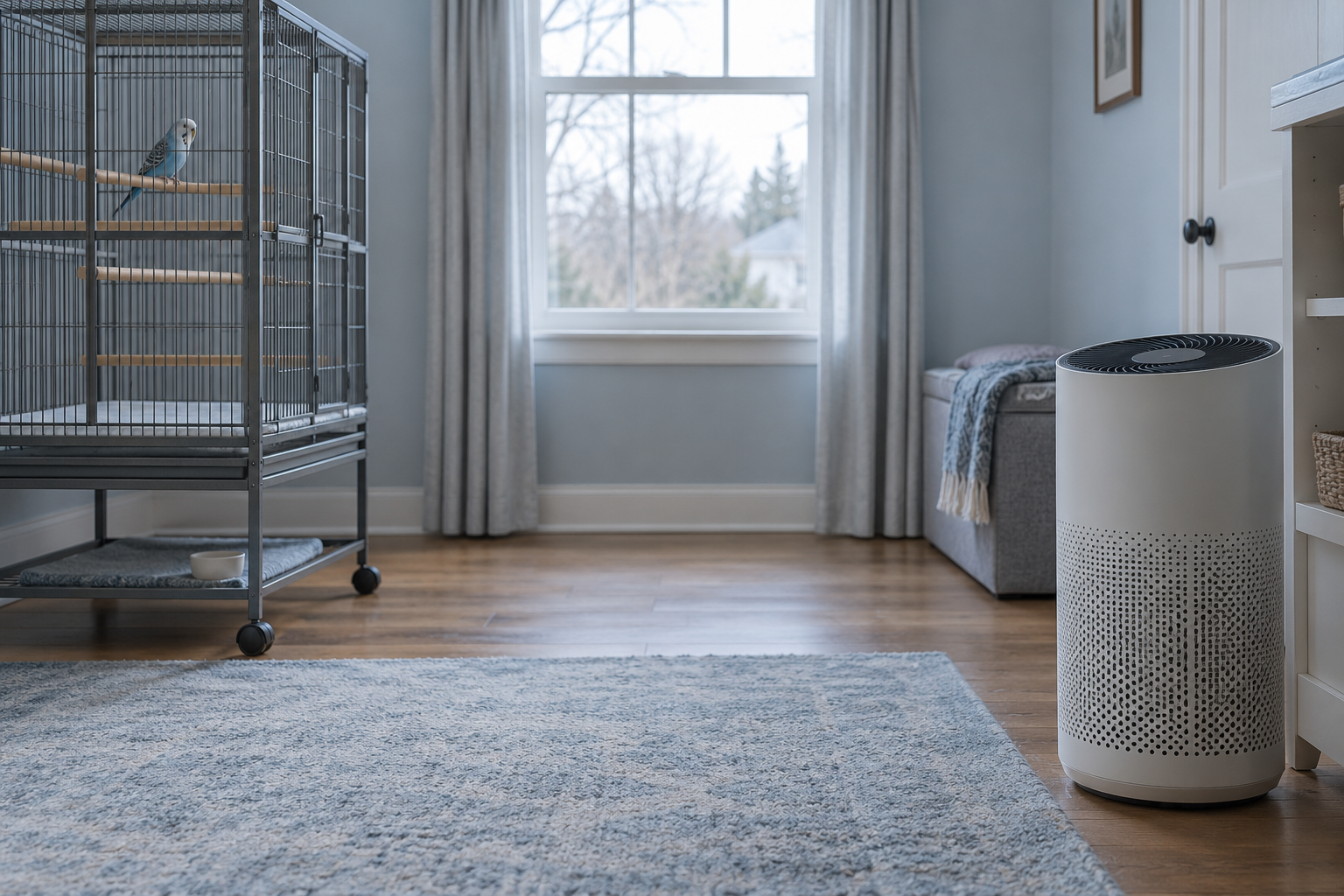
Placement should follow the manual. Airflow needs clearance from walls, curtains, and furniture. The unit should not blow a constant draft directly at the bird, create a launch hazard, or expose a chewable power cord. It also should not sit where cage debris will immediately block the intake or where mist and splashed water can reach electrical parts.
Keep cleaning the source area. Damp-wipe settled dust where appropriate, vacuum safely away from the bird's stress threshold, maintain the enclosure, and ventilate with clean outdoor air when conditions permit. During smoke events or other unusual air-quality conditions, follow current public-health and avian-veterinary guidance rather than assuming the everyday setup is sufficient.
How to audit a product page

Imagine a listing that promises “whole-home medical-grade purification,” gives a coverage claim of 1,500 square feet, advertises an ion mode, and says filters last “up to” twelve months. The price looks attractive. The evidence is not yet adequate.
First, identify the exact model number; similar names may hide different motors or filters. Find its smoke CADR and the room-size assumptions behind the coverage claim. Check whether the CADR appears in the AHAM Verifide directory or another recognized certification source. Confirm whether the ionizer is absent, permanently off, or user-controlled, then check the exact model in the current CARB directory. “CARB compliant” text on a retailer page is weaker evidence than a matching directory entry.
Next, locate noise values by speed, the replacement-filter part number and price, warranty terms, power use, and required clearance. Search the manual for ozone, ion, plasma, UV, fragrance, and maintenance. Record the date checked because pages and model revisions change.
The product passes only if the remaining evidence fits the room and the household. A missing CADR earns no imaginary score. An unavailable filter is a foreseeable ownership problem. An intolerable high-speed noise level undermines advertised delivery. An ambiguous electronic feature is a reason to choose a simpler model, not a puzzle the bird must live beside.
This method produces no permanent winner, which is a strength. The best category choice is the unit whose current, verifiable specifications support sustained mechanical particle filtration in the actual room—while cleaning, source control, safe ventilation, and veterinary care continue doing their separate jobs.