A perch is not simply a place to park a bird. It shapes how the feet grip, where the bird travels, whether food and water stay clean, and how easily an owner can inspect and maintain the cage. That is why the useful question is not “What is the best perch?” but “What job should each perch do?”
Natural branches, smooth dowels, rope, platforms, and swings each offer something different. Each can also fail through poor sizing, unsafe material, bad placement, wear, or inadequate cleaning. A safer setup combines purposes and leaves enough open space for movement.
The goal is varied, stable foot use
Association of Avian Veterinarians guidance recommends perches of varying diameter and warns that a smooth dowel of unvarying diameter should not be the only perch available. RSPCA guidance likewise recommends natural wooden perches in different sizes and thicknesses, placed at different angles to support movement and climbing.
Variation does not mean adding every texture available. Compare a perch across seven questions:
- Is its diameter appropriate for this bird's feet?
- Does it add a useful grip or resting position?
- Is it stable enough for the intended activity?
- Can it be cleaned and dried thoroughly?
- How will this bird chew, fray, or dismantle it?
- Can the entire surface and hardware be inspected?
- Does its position create a clear route rather than clutter?
A single smooth dowel provides one repeated grip. Five crowded perches can be worse if the bird cannot stretch, turn, hop, or fly safely. The system matters more than the item count.
Natural branches and dowels
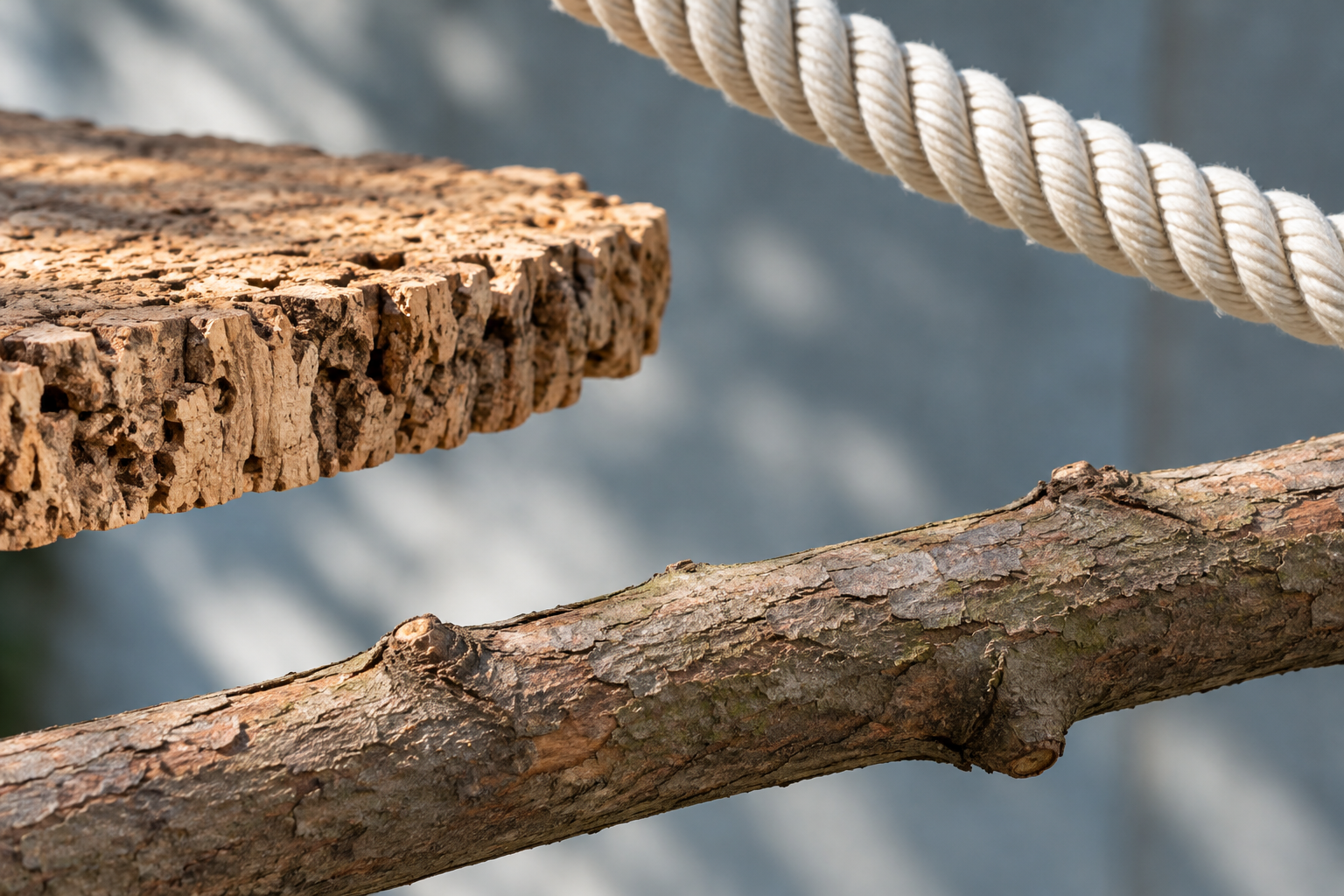
Natural branches can provide changing diameter, irregular angles, bark texture, and something appropriate to chew. That variety is their main advantage. It is also their main inspection challenge: cracks, bark pockets, sap, splinters, droppings, and chewed areas require close attention.
Use only wood identified as non-toxic for birds and known to be free from pesticide, roadside, fungal, and other contamination. Regional plant identification matters; a generic internet list cannot verify a branch collected locally. Purchased natural-wood perches reduce some sourcing uncertainty, but they still need cleaning, secure hardware, and routine inspection. Replace a branch when chewing creates sharp points or when its surface can no longer be cleaned reliably.
Smooth dowels are easy to fit, scrub, and replace. A short dowel may serve as a predictable bridge to a food station or door. Its weakness is uniformity. If it becomes the main sleeping and daytime surface, the feet meet the same diameter and pressure pattern repeatedly. It also offers little chewing or texture.
Keep a dowel only when it has a clear function and the cage includes better variation elsewhere. Check that it does not rotate unexpectedly, span so much of the cage that it blocks flight, or position the tail against dirty bars. Sandpaper sleeves are not a remedy. AAV and veterinary guidance warn that abrasive perch covers may irritate or injure the feet.
Rope, platforms, and swings
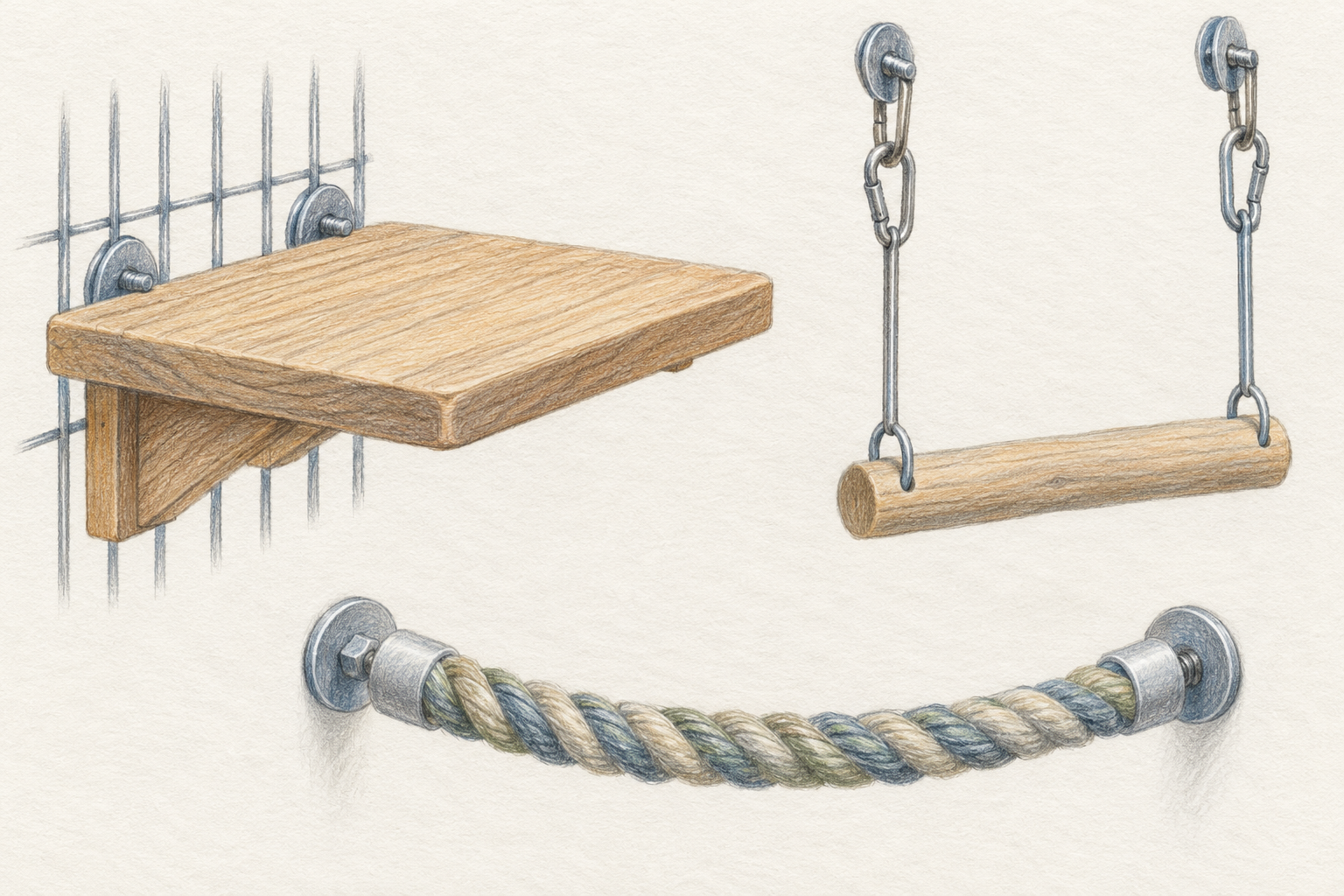
Rope perches can create a curved route and a softer, flexible grip. They may be useful for climbing or for an individual that manages a hard surface poorly. Their safety depends heavily on the bird. VCA guidance warns that chewed rope can release strands that entangle toes or feet, and loose fibers may be swallowed. Inspect the full length daily, including the ends and attachment points. Remove it at the first meaningful fray; trimming a visible loop does not prove the interior is sound.
Rope must also be washable and fully dry before reuse. A damp, soiled braid is not a comfortable perch. Keep a spare if rope is part of an essential route so the cage remains usable during cleaning.
Platforms allow the feet to rest in a different position and can support a bird that struggles to grip continuously. They also create a surface for a small activity or a stable pause between routes. The tradeoff is hygiene: a flat shelf readily collects droppings, wet food, and shredded material. Place it where nothing above soils it, choose a surface that can be inspected, and clean it before residue hardens.
A platform is not an automatic treatment for weakness, arthritis, or foot lesions. A bird that falls, favors one foot, loses grip, or changes movement needs an avian veterinary assessment. The setup may then be adapted around that individual's diagnosis and ability.
Swings add controlled movement and can support balance and activity. Some birds sleep on them; others avoid them. Start with a stable, low-risk position and watch how the bird mounts, turns, and dismounts. Make sure the swing cannot strike a wall, dish, toy, or another bird. Check chains, links, rope, and connectors for gaps that could catch toes or a beak.
Placement changes the answer
The same perch can be useful in one location and troublesome in another. Avoid placing any perch where droppings can fall into food, water, another bird's space, or onto a lower high-use perch. Keep tail feathers clear of cage sides, and make sure a bird can reach a door or station without squeezing behind hardware.
High positions deserve special attention because many birds prefer them for rest. A rough or difficult-to-clean perch should not become the only attractive sleeping place merely because it sits highest. Offer an appropriate, stable rest option and arrange alternatives slightly lower rather than creating a single contested spot.
Think in routes. An active bird may fly or hop between widely spaced natural branches, climb a rope curve, pause on a platform, and use a short dowel near a door. A bird with limited mobility may need shorter, lower transitions and protected landing areas. In both cases, food, water, and enrichment should be reachable without forcing one risky jump.
Leave open space. Perches are infrastructure, not decoration; every added item should justify the movement it enables.
Build two purpose-based mixes
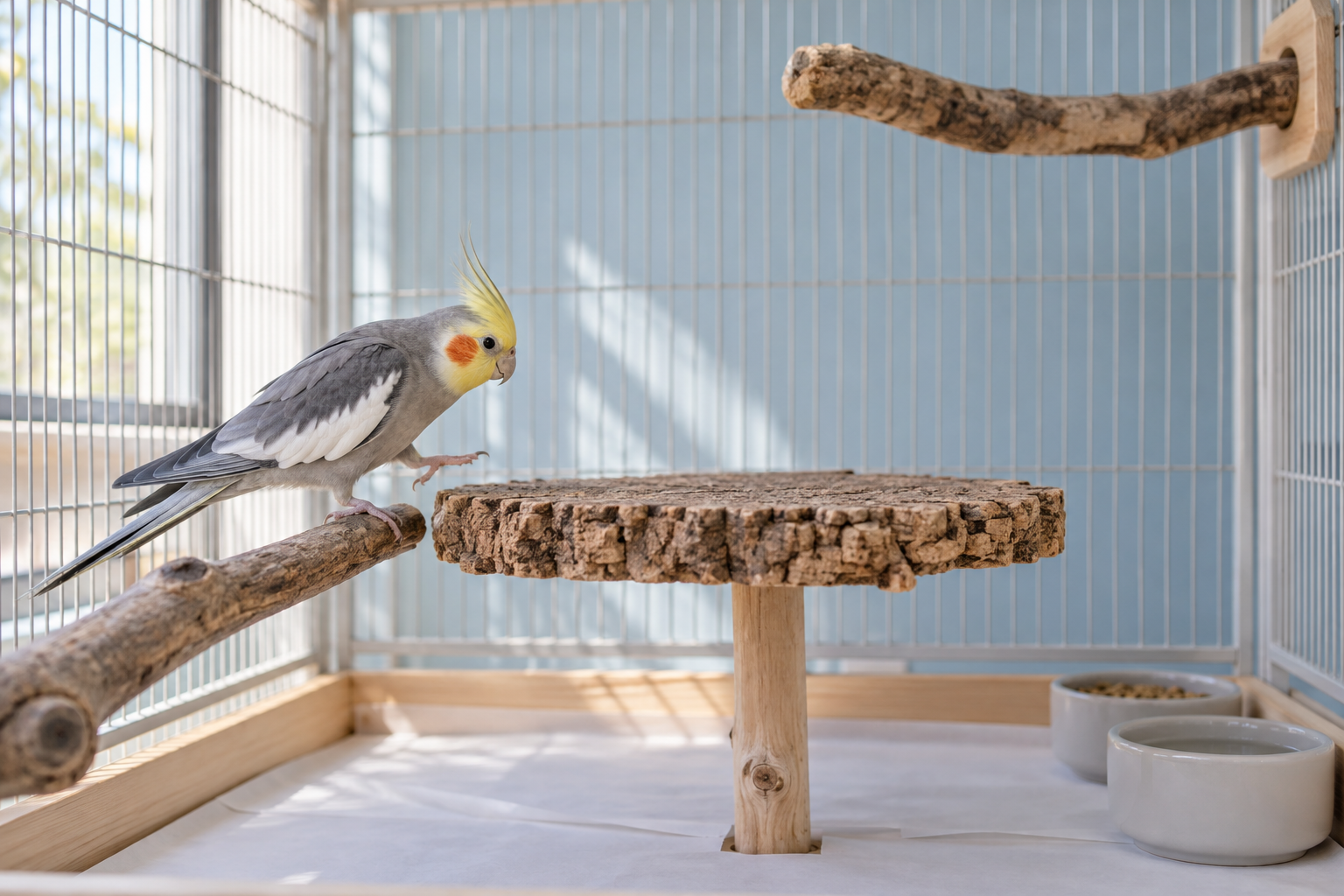
For a hypothetical active small parrot, a useful mix might include two clean natural branches with different diameters on opposite sides, a short rope route used only if the bird does not fray it, one swing away from dishes, and a small platform for a change of foot position. A smooth dowel could remain near a door as a training station. The exact dimensions depend on the bird, cage, and safe flight path.
For a hypothetical bird with reduced mobility, the design question changes from maximizing challenge to making essential movement reliable. Lower natural perches, a broad platform, short horizontal connections, and easy access to food and water may help. Hard falls must be reduced. This is not a do-it-yourself medical prescription: an avian veterinarian should identify why mobility changed and advise on height, grip, bedding, and exercise.
Whichever mix you build, run a weekly inspection: test every attachment, feel for sharp points, examine rope under good light, scrub soiled surfaces, confirm that platforms dry completely, and watch the bird move through the cage. Daily observation should catch sudden fraying, splintering, contamination, or avoidance sooner.
No perch material wins every category. Natural wood offers variation, dowels offer predictability, rope offers flexible routes, platforms offer a different resting surface, and swings add movement. Safety comes from assigning each a purpose, observing the individual bird, and removing an item when its condition or use no longer supports that purpose.