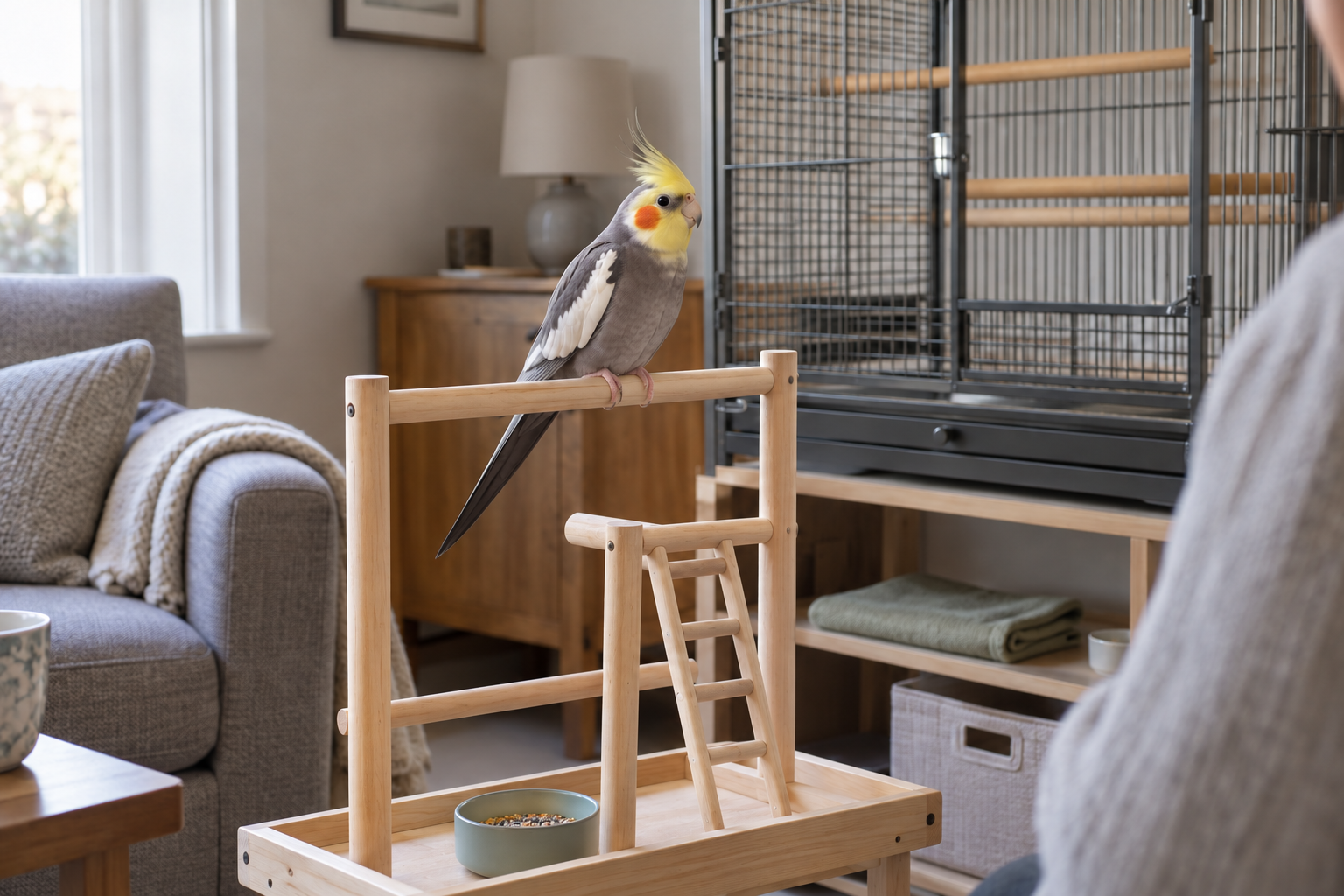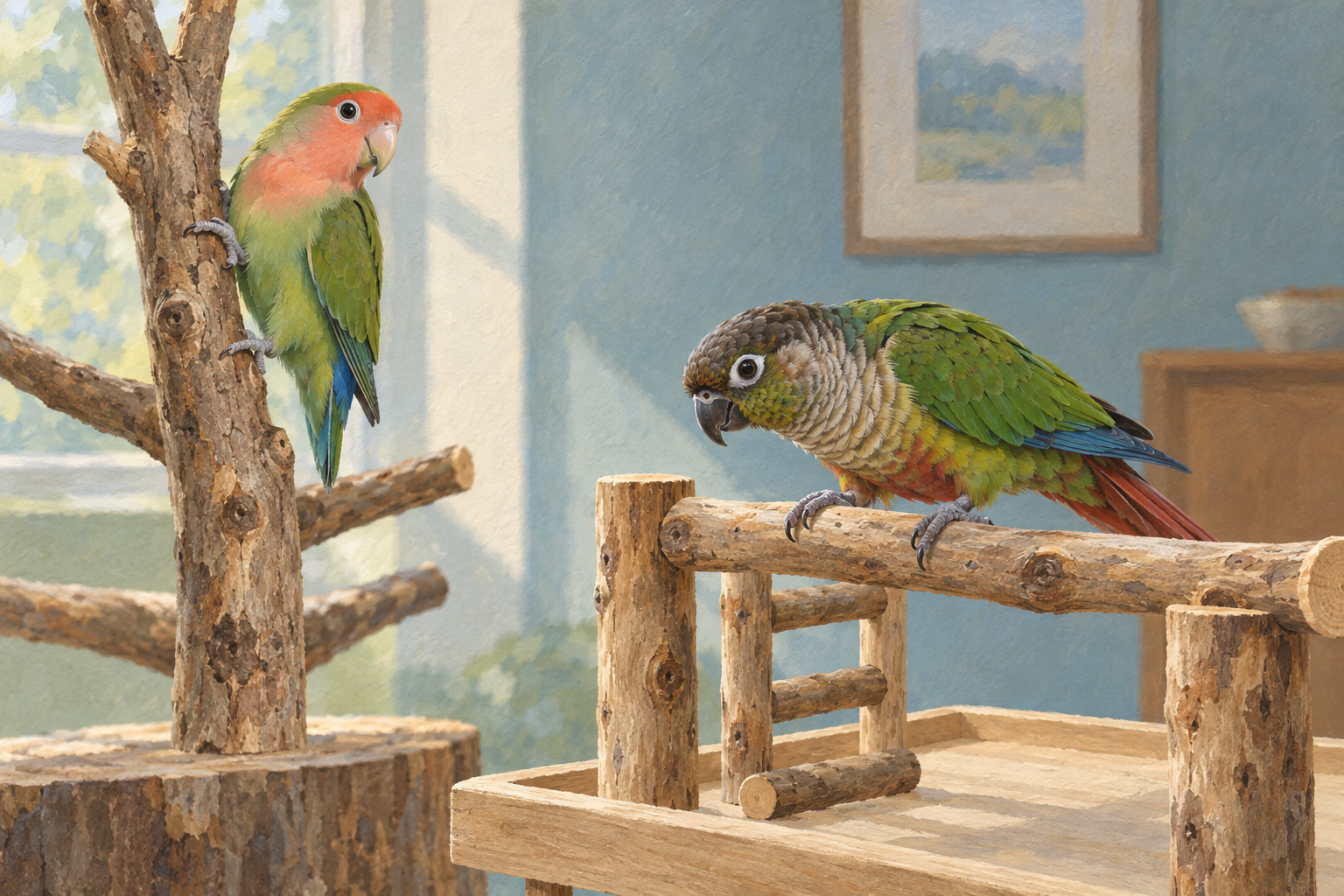
Lovebirds and green-cheeked conures can both appeal to someone who wants a small, active parrot. Their size overlap can make the choice look cosmetic. It is not. The practical differences appear through a day: how a bird moves, explores with its beak, calls for contact, responds to hands, and uses enrichment.
This comparison uses the rosy-faced lovebird—the peach-faced species commonly kept as a companion—as the lovebird reference. Other lovebird species differ. It also treats species descriptions as planning clues, not personality promises. Either bird may be reserved, bold, tactile, independent, quiet for its species, or unexpectedly loud in a particular home.
Similar size, different day
World Parrot Trust lists the rosy-faced lovebird at about 15 centimeters and 46–63 grams, while the green-cheeked conure is longer at about 26 centimeters and 60–80 grams. Much of the conure's extra length is tail, but that still affects turning room, carrier fit, door clearance, and how furnishings are arranged.
Both need more than a cage that merely contains the body. They need uncluttered movement space, safe exercise, foraging, chewable materials, rest, predictable sleep, and regular veterinary care. The useful comparison is therefore not “which is easier?” It is “which pattern of daily effort can this household deliver consistently?”
Measure the intended cage, carrier, play stand, and safe flight path before meeting a bird. A few centimeters of body length can change turning clearance once a long tail, bowls, perches, and toys occupy the same space.
Morning energy and contact
Imagine two fictional birds in identical households. Both wake after a protected sleep period, receive fresh water and food, and have a short training session before the caregiver starts work.
The rosy-faced lovebird immediately investigates paper strips, climbs through a route of perches, and carries material toward a favored corner. VCA describes lovebirds as inquisitive, playful birds that enjoy chewing paper and soft wood; World Parrot Trust recommends climbing, puzzle, and chew items for rosy-faced lovebirds. The caregiver redirects nesting-like material management without turning the morning into constant handling.
The green-cheeked conure bathes, works at a foraging toy, and moves repeatedly between a swing and a stand. World Parrot Trust describes the species as very active and recommends foraging toys, ladders, swings, and safe chew materials. The caregiver has planned a broader route that accommodates the conure's longer tail and active movement.
Neither diary predicts an individual bird. It shows the workload: both homes need rotation, cleaning, safe movement, and observation. A person who wants a bird to sit still for long periods may find either pattern frustrating. A person who enjoys arranging activities may find either engaging, but should still plan for independent play rather than becoming the only source of stimulation.
Beaks, chewing, and enrichment load

Both species use the beak to investigate, climb, dismantle, and manipulate. That is normal behavior, not evidence that a bird is “bad.” The household must protect cords, furniture, plants, paint, metals, and small swallowable parts while offering legal things to destroy.
For the lovebird, lightweight paper, bird-safe soft wood, climbing items, and puzzle opportunities may support a fast, busy style of manipulation. Nesting behavior requires attention: enclosed spaces and abundant shreddable strips can become more than casual play for some mature birds. The answer is not punishment. It is to observe patterns, remove risky or strongly triggering setups, and ask an avian veterinarian about persistent reproductive behavior.
For the green-cheeked conure, use sturdy, size-appropriate items that invite foraging, chewing, climbing, and bathing. A longer tail can brush dirty bars or dishes if perches are badly placed. Hardware must be checked for openings or moving parts that can trap toes or beaks. No article can certify an object for every bird; supervision reveals how that individual actually dismantles it.
The enrichment burden is therefore different in detail, not optional in either case. A useful weekly routine includes cleaning, rotating a few items without overcrowding the cage, inspecting ropes and connectors, replacing splintered or frayed parts, and keeping easy activities available when a new challenge is introduced. Buying many toys at once does not replace this observation cycle.
Noise is a pattern, not one number

World Parrot Trust describes rosy-faced lovebird calls as shrill and metallic, sometimes repeated more rapidly when alarmed. Its green-cheeked conure profile describes rapid repeated flight calls along with sharp or melodious sounds. These descriptions help identify kind of sound; they do not provide a matched loudness test in a living room.
Listen for timing as well as volume. Morning contact calls, alarm responses, flock calls when a person leaves, and excited vocalizing during activity can feel very different from occasional isolated sounds. Room acoustics, the number of birds, sightlines to windows, reinforcement history, and household movement all influence what the family experiences.
Do not rely on claims that a green-cheek is “quiet for a conure” or that a lovebird's small body means a small voice. Visit adult birds during active hours if possible. Ask whether repeated high-pitched sound, rather than peak volume alone, is compatible with neighbors, calls, sleep schedules, and sensory needs. If the home requires silence, neither species is a safe bet.
Handling, independence, and individual history
Lovebirds and green-cheeked conures are often marketed with affectionate personality labels. Those labels can create a harmful contract: the bird is expected to accept hands, cuddling, or strangers because the species is reputed to be social. Real handling comfort depends on early experience, current health, reinforcement history, context, and the bird's choice at that moment.
Use approach behavior as information. A bird that leans away, freezes, opens its beak, tightens its feathers, or retreats is asking for more distance. A bird that steps toward a familiar hand may still refuse later. Reward-based training can make transport, stationing, and routine care easier without treating touch as the goal.
The two hypothetical birds may also distribute attention differently. The lovebird might prefer working beside the caregiver but avoid fingers. The conure might seek close contact with one person and defend that access. Either outcome requires boundaries, more than one safe way to move the bird, and interactions that do not imitate an exclusive mate relationship.
Commitment test and the “neither” outcome
World Parrot Trust lists about 15 years as the rosy-faced lovebird's potential longevity and more than 10 years for the green-cheeked conure. Other reliable references give different ranges, which is exactly why lifespan should be treated as a long planning horizon rather than a countdown. Housing, health, prior care, diet, and individual biology affect outcomes.
Before choosing, answer the same questions for both birds:
- Can the home fit a roomy setup, safe exercise route, carrier, and replacement furnishings?
- Can it tolerate repeated calls and debris during active periods?
- Is there time for daily observation, enrichment, training, and cleanup without demanding affection?
- Is an avian veterinarian reachable, and can the budget absorb routine and emergency care?
- Would the commitment survive moves, schedule changes, partners, children, or a bird that dislikes handling?
A household that enjoys compact climbing activities and can thoughtfully manage shredding or nesting cues may lean toward a lovebird. One prepared for a longer-tailed, very active bird with substantial foraging, chewing, and bathing opportunities may lean toward a green-cheeked conure. Those are conditional fits, not guarantees.
If the decision depends on a cuddly personality, predictable volume, or effortless entertainment, the honest result is neither. The better choice is not the prettier bird or the species with the friendliest reputation. It is the individual whose real needs can be met even when daily life is messier, louder, and less tactile than the household imagined.